
My dad’s gadget-loving side didn’t always overlap with fun, though it was usually interesting. The mechanical wind-up burglar alarm attached with thin nylon string to the dog door and doorframe was a good example. Odd and smart, though it only went off by accident early in the morning when one of my folks forgot to unset it, so never stopped a robbery.
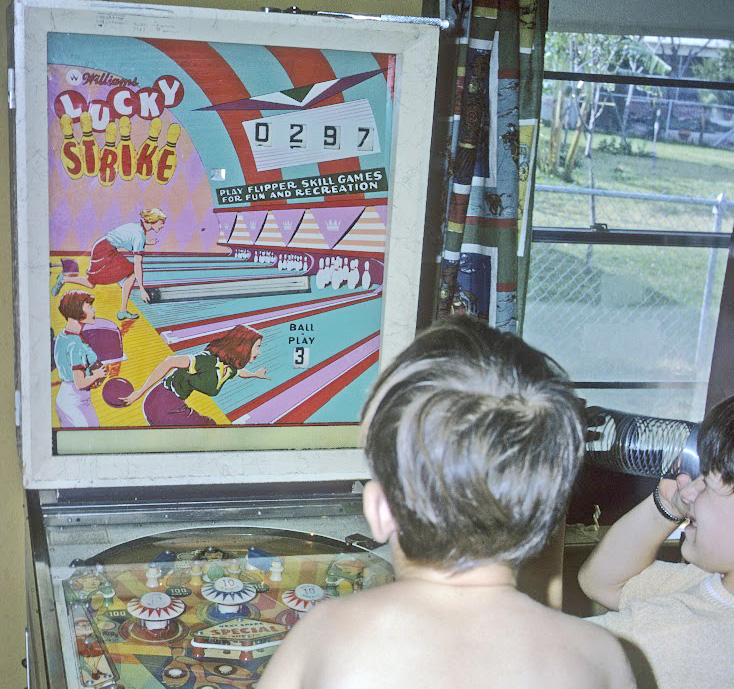
But a lot of his projects were fun, or at least fun to me. A dimmer crossfader that let me design multi-projector slide shows. The motor-powered witch that flew between our front yard trees every Halloween. A detailed assessment of how the special effects in the Pirates of the Caribbean ride are done. A pinball machine and shooting gallery game that he got from a used amusements dealer to fix up.
The Williams Lucky Strike pinball machine, first manufactured in 1965, was a giant contraption. 6 foot tall at the back, 5 foot deep, over 200 pounds full of physical circuits and switches. Mechanical relays powered the actions when the pinball hit one of the bumpers. Gears with four plastic wheels numbered 0 to 9 kept score. 9,999 was the highest the display could show, though I don’t remember ever getting close to that. It was before microprocessors or anything digital, and dad explained things like coils, solenoids, steppers. I couldn’t tell you what any of those are, but it was cool to watch them, deep in the guts of the machine, do their work while someone played the game.
Somewhere in there was a little box with a small metal ball on a track. Unlike in a video game, bumping or wriggling the machine could easily affect the path of the pinballs. This game was IRL! So if jiggled or pushed too hard, the ball in this little sensor would roll to one side or the other and, if it came into contact with the sensor at either end, cause a “Tilt.” Everything shut off, except for the TILT light. The game was over, and a new one couldn’t be started until someone with a key came and reset the thing, no doubt giving the Tilter a little lecture about not busting the games. (My brother and I, having the key, would tilt it again and again, to learn exactly how much nudging we could get away with.)
I’ve been thinking about the Tilt sensor a lot lately as we navigate the latest offspring developments. If you know me, you know that my own happy memories of school, perhaps a bit rose-tinted in the rear view mirror, are not shared by either child. As bits of proof accumulate to confirm this difference — grades, calls from the school, things that need attention in this class or that — I tend to fluctuate from a calm, probably mostly realistic view of the situation (perhaps with the smallest drop of denial) into full “Tilt” mode. Game over. Crisis. Panic. The bells inside my head ring and the light of reason snaps off. I’ve been a fool, we’ve been fools, to think this is anything less than a full-alarm disaster.
Somewhere between these extremes lies the truth. Of course we’ve got to respond to the bad news, but I need to figure out how to turn down the freakout. It’s not helping, and nobody likes that damn pinging bell. (Is it just in my head?)
Jay has me watching short videos by a therapist coach helping empty nest moms navigate their new role with their young adults. Is this a dangerous situation? Is this my problem to deal with? Is this something my adult child can learn from, and probably handle? Have they even asked for my help? Her core message is that our young adults need to make their own mistakes and that even if we “know” the best thing to do, we’re not helping by trying to steer things so much. They have got to learn these things for themselves. This has been super useful for our out-of-the-house kid. But the younger is still in high school, still a minor. We’ve still got a (teeny) little bit of time where we can set the rules and keep him, I hope, from the worst mistakes.
But with a tilt sensor ready to classify every small thing as a “worst mistake,” some finessing is in order.
I’ve been trying to visualize my dad, who would not while living have been able to discuss emotional regulation for five seconds, helping me with the tilt sensor. I mean, it’s a little contraption there in the machine. There must be a way to adjust the sensitivity. Perhaps a change to the steel ball (bigger? smaller?), or making the track it runs on a little longer so it takes longer to reach the end. Or maybe a tiny shock absorber dampens the input just a little. These are the things my dad could help with, would love to and insist on helping with, and since the pinball machine now exists only in my mind, I don’t see why I can’t get his help with my own wiring. With gadgets he was patient, clever, relentless. I know there will be a way. Just thinking about how much he’d love the challenge feels like it lightens the sensitivity at least a little.